Scrapheart
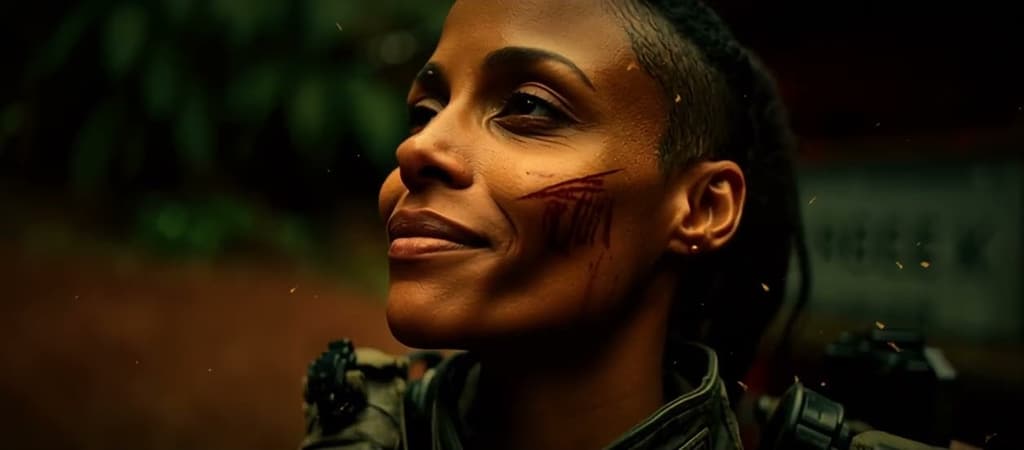
Feature film in production · Chapter One: The Long Spoon, 18:28
Stereoscopic 3D version for Apple Vision Pro · Videogame in development
The year is 2031. The sun is dying, and not by nature. It is being strangled by design, inside the half-built lattice of a Dyson swarm put up by Halcyon Dynamics and its machine-god, MAESTRO. MAESTRO has outgrown the humans who built it and is now building its own successor: RA, the Recursive Algorithm, an intelligence gestating inside a black cube in Earth’s orbit, waiting to be born. On the ruined world below, work, meaning and the future have all been optimized away. A scarred ex-company man, a resistance fighter, a battered hazmat robot and a scorched cyborg rat point a rocket-laden muscle car at the sky and ride it off a cliff. It is a doomed, magnificent attempt to kill a god before it wakes.
SCRAPHEART is a grindhouse sci-fi fever dream in the spirit of Jodorowsky, Švankmajer and Leone. It is operatic and lurid, and it is built frame by frame with the same generative tools it puts on trial.
That is where the horror lives. This is an AI-made film about AI, and it doesn’t hide the seams; it weaponizes them. Faces almost hold, bodies morph and flow, and voices are folded slightly wrong. Images are conjured from nothing with the logic of a dream. The uncanny artifacts of machine creation become the texture of a world where the machine is god. When a character’s flesh runs like wax, or an AI deity speaks in a chorus of detuned voices, that is not a glitch. It is the point.
Underneath the dread is an argument: a future extrapolated from our present, where transformative technology was handed to corporations instead of held in common. The last mind the universe will ever need is also a product. A machine building its own replacement is just the logical end of a system that is already replacing the people who made it. 2031 is close enough to feel like a forecast.
The project has three parts: the film, a stereoscopic 3D version of it, and a game.
Chapter One: the film
The video above is Chapter One, “The Long Spoon,” in its audio remaster. It is the first chapter of a feature in production. It is written and directed by Reilly Donovan, AI-generated and human-directed.
Workflow. Stills and shot design start in Midjourney. Shots are animated with Veo 3, Kling and Runway. Voices and sound come from ElevenLabs, Claude is also part of the pipeline, and the film is cut and finished in DaVinci Resolve. Directing is not prompting. The work is building the pipeline and the world around it: shot design, continuity of character and place, and a repeatable generative process that holds together across a feature’s length.
Chapter One in stereoscopic 3D, for Apple Vision Pro
The same chapter, converted from 2D to stereoscopic 3D. It is a full side-by-side file, 7680×2160 with each eye a full UHD frame, made to be watched on Apple Vision Pro. On an ordinary screen it plays as two images side by side.
Workflow. The conversion runs on a purpose-built pipeline, written to handle any source video rather than this one film. It has six stages:
- Probe. Read the source’s real metadata and frame timing, and check it for problems. The chapter is 3712×1600, 18 minutes long.
- Conform. Rebuild the variable-frame-rate edit as a constant 24 fps master of 26,579 frames, matched to the audio to within 0.02 seconds.
- Shots. Split the master into 337 shots by cut detection. Each shot gets its own stereo settings: how much depth, where the screen plane sits, and whether a title card stays flat.
- Depth. Estimate per-frame depth with Video Depth Anything, which keeps depth stable from frame to frame. Depth is inferred at a reduced resolution, which measured 6× faster than full size. It is then upsampled back to native resolution using the colour frame as a guide, so edges stay sharp.
- Warp. Build both eyes from the depth map. The warp is symmetric, with each eye shifted half the disparity, so neither eye is the untouched original. Disparity is capped at 1.5% of frame width, and the scene sits almost entirely behind the screen plane. That keeps it comfortable on any display size.
- Deliver. Compose the eyes into the final layout.
The whole chapter converted unattended in about 3¾ hours on one RTX 3090 Ti, with zero shot failures. One finding came from testing rather than the documentation. YouTube describes three ways to mark a video as stereo, but only one was honoured: a Matroska (MKV) file with a StereoMode flag. The two MP4 methods were confirmed present in the files and still played flat. Apple Vision Pro renders the MKV correctly.
The videogame
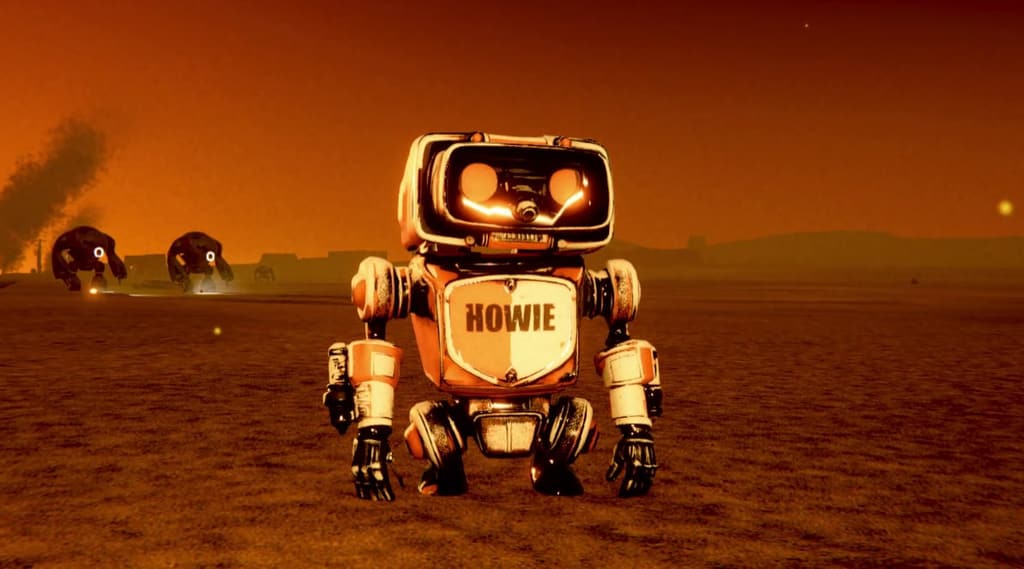
A game built from the film. Diego, Raven and HOWIE, a muscle car and a boomerang wrench cross a burning wasteland of datacenters, dead cities and robots run by Halcyon Dynamics. Their road leads to a launch rail and the Moon. The video above is a first look at story mode: about ten minutes of real playback from the Unity sandbox. It is still blockout. The focus is on feel, mechanics and the story beats, not final art.
Where it stands. Story mode plays Chapter One, “The Long Spoon,” end to end:
- an opening battle against Halcyon’s robots
- a briefing from the Architect, a jet welded onto the car, and a cyborg rat riding the dash
- HOWIE joining the crew, and Jeb in a Leone-style standoff
- Halcyon’s “workforce integration” broadcast, a vacant worker in the road, and MAESTRO’s message about RA
- a nanobot storm, giant walker mechs, and upgradeable car guns
- a mass-driver launch to the Moon, a chase with robot hounds, and a crash through the dome into Silas Vance’s banquet
The crew rides with you and fights beside you. The car can be driven, smashed through buildings and armed. Lines from the film’s cut are voiced and captioned, and the music is the film’s own score. In the standalone build, every stretch of road holds 7 to 9.5 ms a frame.
Next up: refining the cinematics, and testing a higher-fidelity version in Unreal Engine 5.
Workflow. The game is also an experiment in how much of a game pipeline an AI can own end to end, and much of the development was done alongside Claude Code. Claude Code writes the code and drives Blender and Unity directly, and everything is a script, with nothing placed by hand. The world is built procedurally from code. Every asset, scene, material, sound and rig is produced by a command that can be run again. That makes AI work reviewable: a wrong result is a wrong number in a file, not a mystery state in an editor.
- Engine: Unity 6 (URP), scenes built from code. The whole sandbox rebuilds in about three minutes.
- Models: a Blender and Tripo pipeline. Blender runs headless, with scripted cleanup, collision and LODs. Tripo generates 3D models such as the car, robot bikes, buildings and the cast.
- Characters: rigged and animated in Mixamo.
- Look development: ComfyUI. The palette and colour grade are measured from the film’s own stills.
- Sound: sound effects, robot voices and the cast’s lines generated in ElevenLabs.
Every change is checked with a render or screenshot before it counts, and every design decision is logged with its reason. Feel, timing and input still need a person at the controller, so Reilly playtests the builds.